
Navigating the Gray Areas: A Comprehensive Review of “Ethical Dilemmas and Decisions in Criminal Justice (10th Edition)”
The criminal justice system is a pillar of society, endowed with the profound power to deprive individuals of their liberty, property, and even their lives. This immense power comes with an equally immense responsibility: the unwavering commitment to justice, fairness, and morality. Yet, every day, professionals in law enforcement, the courts, and corrections are faced with complex situations where the right path is not clearly marked. These are the ethical gray areas that test character, challenge principles, and define the integrity of the entire system.
For students, academics, and seasoned professionals, navigating this moral landscape requires more than just a gut feeling; it demands a structured understanding of ethical theory and its practical application. This is precisely where Joycelyn M. Pollock’s seminal text, “Ethical Dilemmas and Decisions in Criminal Justice (10th Edition)”, becomes an indispensable guide. More than just a textbook, it is a comprehensive toolkit for developing the moral reasoning skills necessary to uphold the highest standards of the profession. In this article, we will delve into the core themes of Pollock’s work, exploring why it stands as a cornerstone of criminal justice ethics education and practice.
The Foundation: Understanding Ethical Frameworks
Before tackling specific dilemmas, Pollock masterfully builds a foundation by introducing the major ethical theories that have guided moral philosophy for centuries. Understanding these frameworks is crucial because they provide the “why” behind our decisions. The book doesn’t just present these theories as abstract concepts; it connects them directly to the real-world scenarios faced by criminal justice professionals.
Deontology: Duty-Based Ethics
Deontology, most famously associated with Immanuel Kant, argues that certain actions are inherently right or wrong, regardless of their consequences. The focus is on duty, rules, and moral obligations. In a criminal justice context, a deontological perspective would hold that police officers have a duty to uphold the law, judges have a duty to be impartial, and corrections officers have a duty to treat inmates humanely, simply because it is the right thing to do. The challenge, as Pollock highlights, is determining which duties take precedence when they conflict.
Utilitarianism: The Greater Good
In stark contrast, utilitarianism, championed by Jeremy Bentham and John Stuart Mill, is a consequentialist theory. It posits that the most ethical choice is the one that produces the greatest good for the greatest number of people. A utilitarian approach might justify certain actions—like a plea bargain that avoids a lengthy trial—if the overall benefit (saving state resources, providing closure for a victim) outweighs the negatives. Pollock uses this framework to explore difficult questions, such as whether the collective security of a community can ever justify infringing on the rights of an individual.
Virtue Ethics: Character Matters
Shifting focus from actions or consequences to the moral agent, virtue ethics asks, “What would a virtuous person do?” Rooted in the philosophy of Aristotle, this theory emphasizes the development of good character traits—such as honesty, courage, compassion, and integrity. For criminal justice professionals, this means that ethical decision-making is less about following a rigid formula and more about cultivating the kind of person who can intuitively make the right choice under pressure. Pollock argues that fostering these virtues is a fundamental goal of professional training and organizational culture.
The Thin Blue Line: A Deep Dive into Police Ethics
Law enforcement officers are the most visible face of the criminal justice system, and their actions are subject to intense public scrutiny. The book dedicates significant attention to the unique ethical pressures they face, from the mundane to the life-threatening.
The Use of Force: Where to Draw the Line?
One of the most critical and contentious issues in police ethics is the use of force. Pollock breaks down the continuum of force, from verbal commands to lethal action, and frames it within the legal doctrine of “objective reasonableness.” The ethical dilemma arises in the split-second decisions officers must make. The book provides real-world case studies, such as high-profile shootings, to analyze how factors like perceived threat, officer training, and community expectations all play a role in determining whether an action was not just legal, but ethical. This is a key area where issues of police accountability are frequently debated.
Noble Cause Corruption: “The Ends Justify the Means”
This is a particularly insidious form of misconduct. Noble cause corruption occurs when an officer bends or breaks the law based on the belief that it is for a good purpose, such as getting a known criminal off the streets. Examples include:
- Planting evidence to secure a conviction.
- Lying on a police report (testilying) to ensure a warrant is issued.
- Conducting illegal searches because the officer “knows” a suspect is guilty.
Pollock masterfully explains how this mindset, while seemingly well-intentioned, erodes the very foundation of the justice system and public trust. It’s a slippery slope from small ethical compromises to major violations of constitutional rights.
Scales of Justice: Ethical Challenges in the Court System
While police operate in the streets, the courts operate in a world of procedure, precedent, and principle. Here, the ethical dilemmas are often more subtle but no less significant.
Prosecutorial Discretion and Ethics
Prosecutors wield immense power. They decide which charges to file, whether to offer a plea bargain, and how to present evidence at trial. This discretion is a necessary part of the system, but it is fraught with ethical peril. Pollock explores the tension between a prosecutor’s duty to “seek justice” (not just convictions) and the pressure to maintain a high conviction rate. Key ethical issues include:
- Brady Violations: The ethical and legal duty to disclose exculpatory evidence to the defense. Withholding such information is a profound ethical breach that can lead to wrongful convictions. You can read more about this in our article on the landmark Brady v. Maryland Supreme Court case.
- Overcharging: Filing more serious charges than are warranted to coerce a defendant into accepting a plea bargain for a lesser offense.
The Defense Attorney’s Moral Obligation
Defense attorneys often face a public perception problem, being seen as defenders of the “guilty.” Pollock clarifies their crucial ethical role: they are not defenders of crime but defenders of the constitutional rights of all citizens. Their primary ethical obligation is zealous advocacy for their client, even if they personally find their client’s actions reprehensible. This includes challenging illegal police conduct, ensuring the prosecution meets its burden of proof, and protecting the client’s right to a fair trial.
Judicial Ethics and Impartiality
Judges are the ultimate arbiters of justice and must be held to the highest ethical standards. Pollock discusses the importance of judicial ethics, focusing on the need for impartiality, integrity, and the appearance of impartiality. Ethical dilemmas for judges can include conflicts of interest, ex parte communications (discussions with one party outside the presence of the other), and managing personal biases to ensure every person who appears before them receives a fair hearing.
Behind Bars: The Complex Ethics of Corrections
Once a person is convicted and sentenced, they enter the world of corrections. This environment, often hidden from public view, presents its own set of profound ethical challenges.
The Duty of Care vs. Security
Corrections officers have a dual, and often conflicting, mission: to securely incarcerate individuals and to ensure their safety and well-being. This creates constant ethical tension. For example, when does an intervention to stop a fight between inmates become excessive force? How does a facility balance security protocols (like cell searches) with an inmate’s right to a modicum of privacy? Pollock uses this dichotomy to explore the daily moral calculations of those who work in prisons and jails.
The Ethics of Punishment and Rehabilitation
The book delves into the philosophical underpinnings of corrections. Is the primary goal of incarceration punishment, deterrence, rehabilitation, or societal protection? The answer to this question shapes every policy, from educational programs to solitary confinement. An ethical approach, Pollock argues, must recognize the humanity of the incarcerated individual and avoid cruel and unusual punishment, while still fulfilling the mandate of the court’s sentence. The rise of private prisons also raises ethical questions about profiting from incarceration, a topic Pollock does not shy away from. For more on official policies and stances, one can refer to the Federal Bureau of Prisons website.
Professionalism and Inmate Relationships
Given the closed and stressful environment of a correctional facility, maintaining professional boundaries is paramount. The book discusses the ethical prohibitions against forming inappropriate relationships with inmates, engaging in contraband trade, or using one’s position for personal gain. It emphasizes that professionalism is the bedrock of a safe and ethical corrections environment.
Key Takeaways from Pollock’s Masterwork
After a thorough exploration of its pages, several core messages from “Ethical Dilemmas and Decisions in Criminal Justice (10th Edition)” become clear.
- Ethics is a Skill, Not an Innate Trait: Moral reasoning can and must be taught and practiced. The book provides the tools for structured ethical analysis.
- There Are No Easy Answers: The purpose of studying ethics is not to find a perfect formula for every situation, but to develop the wisdom to weigh competing values and make the most defensible decision.
- Systemic Issues Matter: Individual ethical failures are often a symptom of broader systemic problems, such as poor leadership, a lack of accountability, or a toxic organizational culture.
- Accountability is Key: A truly ethical system has robust mechanisms for holding individuals and institutions accountable for their actions, from internal affairs to civilian oversight boards.
- The “Gray Area” is Where the Work Happens: The most important ethical decisions are not the obvious ones (e.g., don’t take a bribe) but the difficult ones that lie in the gray areas between competing duties and uncertain outcomes.
Click Here to Purchase Your eBook Now
Why This Book Matters for Every Criminal Justice Professional
For the criminal justice student, this book is the foundation upon which a career can be built with integrity. It provides the language and framework to excel in ethics courses and, more importantly, to enter the workforce with a moral compass already calibrated. It is an excellent resource for anyone exploring criminal justice careers.
For the seasoned professional—be it a police sergeant, a prosecutor, or a warden—Pollock’s work is a vital refresher. It’s a tool for training new recruits, a guide for developing effective policy, and a mirror for self-reflection on one’s own career and the ethical challenges faced along the way. In an era of heightened public scrutiny and rapid social change, a commitment to continuous ethical learning is not a luxury; it is a necessity for maintaining legitimacy.
For the academic or researcher, the 10th Edition is a meticulously updated resource that reflects contemporary debates, including the impact of technology on privacy, the ethics of predictive policing, and the ongoing discussion on systemic bias. It is an essential text for any serious study of modern criminal justice ethics.
Conclusion: Forging an Ethical Path in a Complex World
Joycelyn M. Pollock’s “Ethical Dilemmas and Decisions in Criminal Justice (10th Edition)” is more than a summary of rules and theories. It is a call to action. It challenges every reader to look beyond the black-and-white text of the law and grapple with the profound human consequences of their decisions. The criminal justice system is, at its core, a human system, and it will forever be fraught with moral complexity.
This book does not offer easy answers, because none exist. Instead, it equips us with the intellectual and moral tools to ask the right questions, to analyze our own motivations, and to have the courage to choose the more difficult, but more righteous, path. For anyone who aspires to be part of a justice system that is not only effective but also worthy of public trust, this book is not just recommended reading—it is essential.
Frequently Asked Questions (FAQ)
Q1: Is the 10th Edition of “Ethical Dilemmas and Decisions in Criminal Justice (10th Edition)” significantly different from earlier editions?
A: Yes. The 10th Edition is updated to include contemporary case studies, recent legal rulings, and discussions of modern challenges such as the ethics of police body cameras, the use of AI in sentencing, and the national conversation on racial bias in the criminal justice system.
Q2: Is this book only for students, or can working professionals benefit from it?
A: It is immensely valuable for both. Students get the foundational knowledge they need, while professionals use it as a guide for in-service training, policy development, and as a personal resource for navigating real-world dilemmas they encounter on the job.
Q3: Does the book take a specific ideological stance on criminal justice issues?
A: No. Pollock’s strength is her objective, analytical approach. She presents multiple ethical frameworks and perspectives, allowing the reader to critically evaluate different viewpoints and form their own well-reasoned conclusions. The book is a tool for thinking, not a manifesto.
Ready to master the moral complexities of the criminal justice system? Equip yourself with the knowledge and critical thinking skills to lead with integrity.
Click Here to Purchase Your eBook Now
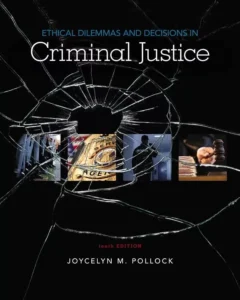
Book Details:
Title: Ethical Dilemmas and Decisions in Criminal Justice (10th Edition)
Author: Joycelyn M. Pollock
ISBN-13: 978-1337558495
Publisher: Cengage Learning
Click Here to Purchase Your eBook Now
One Comment on “Navigating the Gray Areas: A Comprehensive Review of “Ethical Dilemmas and Decisions in Criminal Justice (10th Edition)””